
 24 Feb 2026
 Get Started Today !
Writoholics focus on content structure that can boost visibility significantly in search engines and generative engines. Place a test order today!
Introduction
Most writers misunderstand the difference between blog writing and article writing, not because they lack experience, but because no one clearly explains where one ends and the other begins. As a result, many treat them as the same, and the quality of the content suffers.
This mistake is common.
Blogs:written with the formal tone of research papers
Articles:written too casually, like personal journals.
The writing may still be great, but it often fails to achieve its purpose because the wrong writing FORMAT was used.
Format is not a stylistic preference. It is a strategic decision that determines tone, structure, research depth, point of view, and ultimately whether the content earns the trust and response it was written to gain.
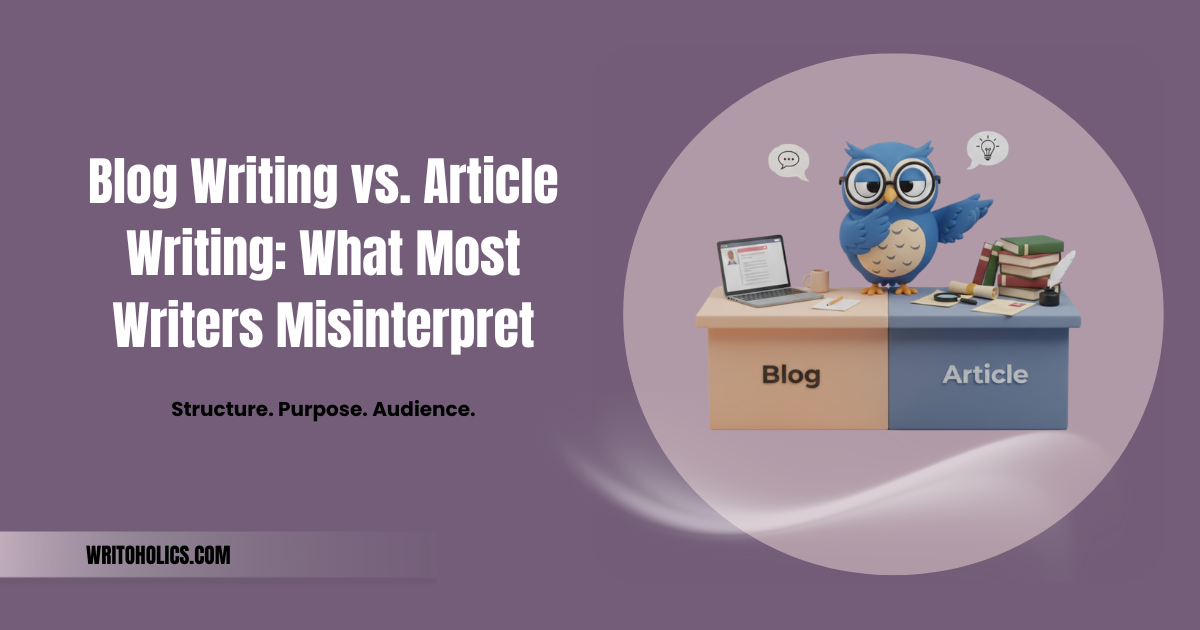
In simple words, blog writing and article writing are two distinct writing formats created for different purposes, audiences, and outcomes.
Blog writing → more casual and conversational piece of content that is regularly published to connect with readers, build relationships, and keep them engaged.
Article writing → more structured and well-researched piece of content written to inform, educate, or share expert knowledge. It usually requires greater accuracy, detail, and research than a typical blog post.
Both formats serve valuable but different purposes. Confusing them means doing neither job well.
This guide covers exactly where that confusion comes from and
- What each writing format means and when it should be used
- How blogs and articles differ in tone, structure, SEO intent, research requirements, and publishing style
- The four types of article writing and when each one applies
- How to choose the most effective format for your content goals
Blog vs. Article: A Simple Comparison Guide
Blog
Point of View: First-person (“I,” “we”) or second-person (“you”)
Tone: Conversational, friendly.
Length: 600-1,500 words.
Structure: Flexible and easy to skim.
Research: Light to moderate.
Goal: Drive traffic & encourage interaction
Article
Point of View: Third-person (“they,” “it”)
Tone: Formal, Informative.
Length: 800-2,500+ words.
Structure: Organized and strict.
Research: High. Requires facts and credible resources.
Goal: Inform & educate.
What Is Blog Writing?
A blog is an informal, conversational piece of content regularly published on a digital platform.
If you don’t know about the history of blogs, here’s something that might catch your interest.
Blogging was there from the early 1990s. Back then it was called “weblog.” The term "weblog" was coined by Jorn Barger in December of 1997, which was later shortened to "blog" by Peter Merholz in 1999.
Early blogs were simple websites where people could post updates about their lives, thoughts, and interests. It became a digital extension of personal journaling. Today, they have evolved into professional platforms covering news, marketing, technology, travel, law, and health.
Later in 2003, after Google acquired Blogger, it helped blogging explode in mainstream culture. This made it easier for people to create and maintain their own blogs.
These platforms also provided user-friendly interfaces that required zero technical knowledge. Literally anyone could start a blog.
Did you know? There are over 600 million blogs worldwide.
Now coming to blog writing
Blog writing is a way of sharing ideas or opinions on a website in an engaging way. It is usually written in a friendly tone and speaks directly to the reader.
If you look from a business’s standpoint, many of them understand the importance of publishing content. But the problem is they don’t do that regularly. This is where professional blog post writing services make a huge difference.
A reliable blog post writing service helps brands to stay consistent by creating content calendars and delivering posts on time. Beyond this, they also ensure a consistent tone and voice.
Professional writers who write for such agencies study brand guidelines and make strategies to produce content that reflects the company’s identity.
What Is Article Writing?
An article, on the flip side, is a well-researched piece of writing designed to inform or educate.
Article writing is the process of crafting structured and engaging content that is intended for publication in magazines, newspapers, and online platforms.
Article writing is of four types.
1. Expository Writing
In this, you share facts and information with the target audience. This type does not express personal opinions. Instead, it relies on factual information and credible sources to support the main idea.
2. Narrative Writing
A narrative is a type of writing that tells a story. It involves constructing a tale that centers around a main character. The plot follows a clear structure:
- Beginning
- Main event
- End
The purpose of narrative writing can be to inform, persuade, or connect.
It is very useful for businesses to engage with customers and build a sense of community.
3. Persuasive Writing
Persuasive writing is a form of communication aimed at convincing readers to adopt the author’s viewpoint. It is commonly utilized in various contexts, including essays, editorials, and product reviews.
The language and tone of persuasive writing are conversational because the writer attempts to connect with readers.
You can find examples of persuasive writing almost everywhere.
- It may be an advertisement.
- It is used in marketing, building brand awareness.
- Even the daily newspaper has plenty of persuasive writing.
4. Descriptive Writing
Descriptive writing is a style of writing that gives a clear, detailed picture of a person, place, or thing. In this type, the main goal is to help the reader imagine the scene as if they were really there.
The writer does this by describing things we can see, hear, smell, taste, and feel.
The main purpose of descriptive writing is to
- Help the reader clearly picture the subject.
- Make the reader feel a certain mood or emotion.
- Make the story feel real and interesting.
- Focus on important parts of the subject.
If you wonder how businesses benefit from article writing, then you’re reading the right article.
Businesses usually hire an article writing service when they need well-researched content. Brands that want to publish
- Educational resources
- Industry reports
- Long-form content.
Unlike blog posts, as you know, articles are meant to inform. This helps the companies that operate in a competitive industry.
The role of professional writers in this process is very important. Professional writers know how to conduct proper research, verify facts, and present information in a logical manner.
Above all that, professional writers can simplify complicated ideas without losing accuracy.
The article can also be in the format of…
- Essays
- Guides
- Review
- Academic
- Editorials
- FAQs
- How-to’s
3 Reasons Why People Get Confused
Many writers struggle to understand the blog vs. article debate. At first look, both seem similar because they are written pieces published online. However, the purpose, tone, structure, and depth vary.
Following are the three major reasons why people and writers misunderstand the difference between a blog and an article.
1. Both Get Published Online
The biggest reason people get confused about blog vs. article writing is that both formats commonly appear on websites.
For example, when someone visits a company website, they may see content labeled as “blog,” but it often looks detailed and research-based like an article.
As everything is published online, the line between blog vs. article is not always clear. As aforementioned, blogs are written to connect with readers, while articles focus more on giving detailed information. This is why the difference between a blog and an article can be hard to notice.
2. Overlapping Structure and Length
Another reason why people get confused between the two is because their structure and length are similar.
Before, means in the past, blogs were short, casual, and based on personal opinions. Articles were longer and deeply researched.
But today, many blogs have a word count of over 1,000 and include facts, examples, stats, etc. Also, both can use headings, bullet points, research, and storytelling. This is why it becomes hard for people to get the difference between a blog and an article.
3. Similar Writing Skills Are Required for Both
Both blog writing and article writing require strong research, clear ideas, proper structure, and strong storytelling. Because the same skills are used in both, many people think they are the same.
But the purpose of each is different. Blogs are written in a friendly tone using “I” or “you” and are meant to connect with readers. Articles are mostly written in a third-person tone and focus on giving trustworthy information.
Representation Between Blog vs. Article
Definition
Blog Writing: A regularly updated post published on a website
Article Writing: A structured piece of writing published in magazines, newspapers, or websites
Point of View
Blog Writing: First-person or second-person (“I,” “we,” “you”)
Article Writing: Third-person (“he,” “she,” “they,” “it”)
Tone
Blog Writing: Casual, friendly, and conversational
Article Writing: Formal, neutral, and professional
Main Goal
Blog Writing: Engage readers, build relationships, and increase website traffic
Article writing: Educate, inform, or explain a topic in depth
Length
Blog Writing: Usually shorter but can range from 600 to 1,500 words
Article Writing: Longer, often 800–2,500+ words
Structure
Blog Writing: Flexible and easy to skim with short paragraphs
Article Writing: Well-organized with a clear introduction, body, and conclusion
Research
Blog Writing: Moderate research; may include personal opinions
Article Writing: Requires strong research
SEO Focus
Blog Writing: Often optimized for search engines
Article Writing: May focus more on depth and authority than SEO alone
Engagement Style
Blog Writing: Encourages comments, shares, and discussions
Article Writing: Focuses on delivering accurate information
Publishing Frequency
Blog Writing: Updated regularly
Article Writing: Published less frequently but with higher depth
Which One Should You Write? Blog or Article
Choosing between a blog and an article depends on
- What’s your purpose?
- Who’s your audience and
- What’s your long-term goal?
If your main goal is to connect with readers, improve SEO, and guide potential customers, then blog is the right choice for you. By now you would’ve known that blogs are more conversational and engagement-driven. Blogs work well when you want to build relationships.
Similarly, if you are looking to establish authority or provide in-depth analysis, then article is your go-to option. Because articles are more structured and are totally focused on information. They follow a clear logical framework.
Understanding these differences between a blog and an article helps you decide which approach goes with your objectives.
Here's the thing you have to remember: the decision should not be based solely on format but on what you want and how your audience prefers to consume information.
Conclusion
In the end, the debate around blog vs. article writing is not about which one is better. It’s about the purpose they serve. What most writers misinterpret is that blogs and articles are not interchangeable.
They may look similar online, but their intent, tone, and strategy are totally different.
A blog is about building connection and making conversation. On the other hand, an article is about structure and authority.
When a writer learns the role each format plays, their writing becomes more focused and effective.
So, here’s the key: know your goal before you start writing. Ask yourself what the readers want. Once you figure out your purpose, choosing the right format becomes easy.
Key Takeaways
- The difference between a blog and an article is drastic.
- A blog is written in an informal tone and is published regularly.
- An article is a formal form of content writing that is designed to inform or educate.
- Article writing is of four types: expository, narrative, persuasive, and descriptive writing.
- Choosing between blog and article depends on purpose, audience, and goal.
- By hiring a blog or article writing service backed by professional writers, businesses ensure that their content not only informs readers but also strengthens their authority in the market.
.jpg)