


 04 May 2026
 Get Started Today !
Writoholics focus on content structure that can boost visibility significantly in search engines and generative engines. Place a test order today!
Legal marketing is no longer driven by visibility alone. Today, content writing in legal marketing determines how law firms build authority, capture demand, and convert high-value clients. Firms that rely only on ads or referrals are increasingly losing ground to those investing in structured legal content marketing ecosystems.
The shift is not about producing more blogs—it’s about producing the right content. High-level legal content writing aligns with search intent, reflects real legal expertise, and guides prospects through complex decision-making journeys. This is why advanced firms prioritize content writing strategies to grow a legal business instead of treating content as a secondary effort.
At a strategic level, why law firms need content writing comes down to control. Firms that invest in content writing in legal marketing control their narrative, their visibility, and their positioning in search results. Without it, they depend entirely on third-party platforms or paid channels.
The Authority Layer: How Legal Content Builds Market Dominance
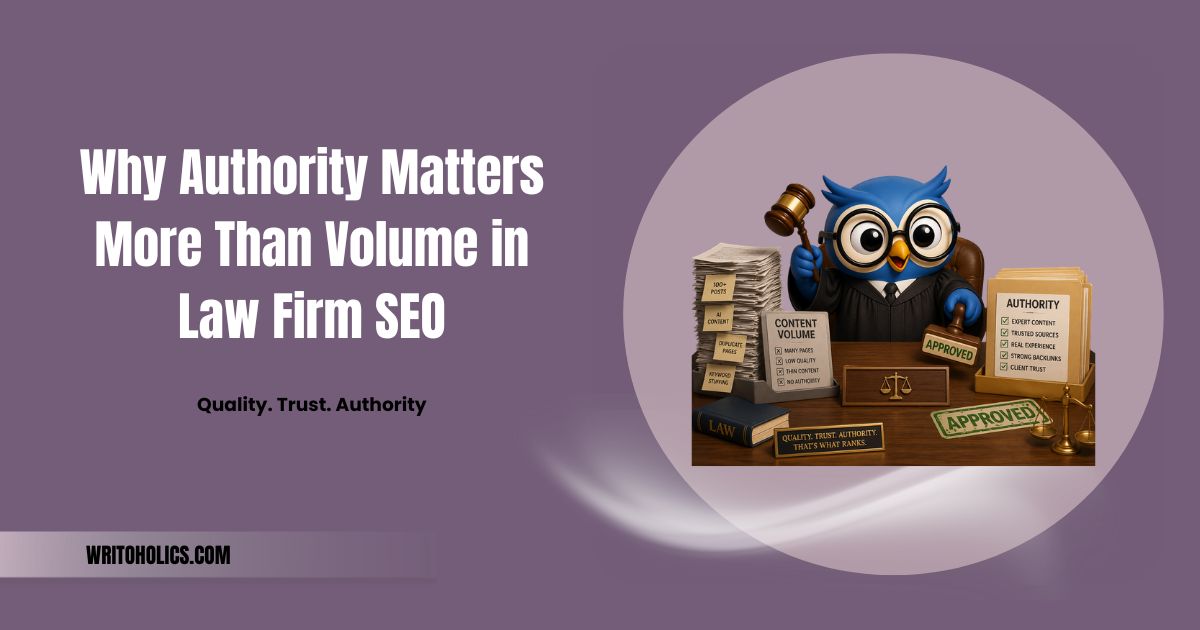
Authority is not claimed in legal marketing—it is demonstrated. Google’s ranking systems heavily prioritize expertise signals, which means legal writing must go beyond surface-level explanations. Strong legal content writing builds topical authority through depth, structure, and interconnectivity.
When executed correctly, content writing in legal marketing creates what is known as a content moat. This makes it difficult for competitors to outrank or replicate your presence. It’s one of the most defensible growth strategies available to law firms.
What High-Authority Legal Content Looks Like
1.Deep, multi-section coverage of legal topics
2. Internal linking across related practice areas
3. Jurisdiction-specific explanations
4. Use of real-world legal scenarios
5. Consistent publishing tied to a strategy
Weak legal writing focuses on definitions. Strong legal content writing focuses on interpretation, application, and outcomes.
Why Law Firms Need Content Writing for Client Acquisition Efficiency
Many firms underestimate how much inefficiency exists in their acquisition process. This is exactly why law firms need content writing—to reduce wasted time on unqualified leads and improve conversion rates before the first consultation.
Strategic legal content marketing acts as a filter. It educates potential clients, answers key objections, and sets expectations. This ensures that when someone reaches out, they are already informed and more likely to convert.
Impact of Content on Lead Quality
| Factor | Without Content | With Legal Content Writing |
| Lead Qualification | Low | High |
| Conversion Rate | Inconsistent | Predictable |
| Time spend per Lead | High | Reduced |
| Client Trust Level | Low | Established Early |
This is where content writing strategies to grow a legal business directly affect profitability. Better content leads to better clients, not just more traffic.
Advanced Search Intent Mapping in Legal Content Marketing
One of the most overlooked aspects of content writing in legal marketing is intent mapping. Not all search queries are equal, and treating them the same leads to underperformance. Advanced legal content writing aligns each piece of content with a specific stage of intent.
Types of Legal Search Intent
Informational Intent
Users want to understand a legal issue - Requires educationl legal writing
Comparative Intent
Users are evaluating options - Requires strategic legal content marketing assets
Transactional Intent
Users are ready to hire - Requires conversion focused legal content writing
Failing to match intent is one of the biggest weaknesses in most content writing services for legal marketing. High-performing firms structure content around intent first, keywords second.
Content Writing as a Long-Term Asset, Not a Campaign
Unlike paid ads, content compounds over time. A single high-performing page created through legal content writing can generate traffic and leads for years. This is why content writing in legal marketing should be treated as an asset, not an expense.
Firms that understand this shift allocate resources differently. Instead of short-term campaigns, they invest in scalable content writing strategies to grow a legal business. Over time, this reduces acquisition costs and increases marketing ROI.
Choosing to hire a legal content writing services provider often accelerates this process. Experienced providers understand how to build content libraries that grow in value rather than decay.
Conversion Engineering in Legal Content Writing
Most firms generate traffic but fail to convert it. The gap lies in weak conversion architecture within their legal content writing. High-performing content writing in legal marketing is engineered to move users toward action without disrupting the informational experience.
Conversion-focused legal writing uses subtle persuasion. It integrates calls-to-action naturally within the content flow. This ensures users are guided rather than pushed.
Core Elements of Conversion-Driven Legal Content
1.Contextual CTAs placed after key insights
2.Clear next steps aligned with user intent
3. Trust signals embedded within content
4. Scannable formatting for faster decision-making
Strong legal content marketing doesn’t wait until the bottom of the page to convert. It creates multiple micro-conversion opportunities throughout.
The Role of Content Structure in Performance
Structure is one of the most underestimated factors in content writing in legal marketing. Even highly informative content underperforms if it lacks readability. Advanced legal content writing prioritizes structure as much as substance.
High-Performance Content Structure
| Element | Purpose |
| Short Paragraphs | Improve readability and engagement |
| Subheadings | Enable scanning and SEO optimization |
| Bullet Points | Simplfy complex legal concepts |
| Tables | Present comparsion clearly |
| Internal Links | Strengthen topical authority |
This structured approach enhances both user experience and ranking potential. It is a key component of effective content writing strategies to grow a legal business.
Topic Clusters: The Backbone of Legal SEO
Isolated blog posts rarely perform well in competitive niches. Instead, legal content marketing relies on topic clusters to build authority. This is a foundational principle in advanced content writing in legal marketing.
A topic cluster consists of one pillar page supported by multiple related articles. Together, they signal expertise to search engines.
Example of a Legal Content Cluster
• Pillar Page: “Personal Injury Law Guide”
• Supporting Content:
“How Liability Is Determined”
“Common Injury Claim Mistakes”
“Settlement Timelines Explained”
This interconnected structure strengthens rankings across all related keywords. It also improves navigation and user engagement.
Internal Linking as a Growth Multiplier
Internal linking is not just navigation—it’s strategy. Strong legal content writing uses internal links to distribute authority across pages. This improves both indexing and ranking performance.
Benefits of Internal Linking in Legal Content
• Reinforces topical relevance
• Increases time on site
• Guides users through the funnel
• Boosts underperforming pages
Many firms overlook this, which weakens their content writing strategies to grow a legal business. Proper linking turns individual pages into a unified growth system.
Content Funnels for Legal Client Acquisition
Content should mirror the client journey. Advanced content writing in legal marketing maps content to funnel stages. This ensures consistent engagement from awareness to conversion.
Legal Content Funnel Breakdown
| Funnel Stage | Content Type | Goal |
| Awareness | Educational Writing | Build trust and visibility |
| Consideration | Case studies, comparison | Position expertise |
| Decision | Landing pages, considerations | Drive conversions |
Each stage requires a different type of legal content writing. Ignoring this structure leads to missed opportunities and lower ROI.
When Content Writing Services for Legal Marketing Become Critical
There is a point where internal teams cannot scale content effectively. This is when content writing services for legal marketing become essential. The challenge is not just writing—it’s strategy, consistency, and optimization.
Firms that hire a legal content writing services provider gain access to specialized expertise. This includes SEO knowledge, legal nuance, and performance tracking. The result is faster and more predictable growth.
What to Look for in a Provider
• Experience with legal writing and compliance
• Understanding of SEO beyond keywords
• Ability to execute long-term strategies
• Proven results in legal content marketing
Choosing the right partner directly impacts the success of content writing in legal marketing efforts.
Scaling Content Without Diluting Expertise
Scaling content is one of the hardest challenges in legal marketing. Increasing output often leads to lower quality. Advanced content writing strategies to grow a legal business focus on maintaining standards while expanding reach.
Scalable Content Systems
1. Standardized content guidelines
2. Editorial workflows and approvals
3. Regular content audits and updates
4. Performance-based optimization
These systems ensure consistency across all legal content writing efforts. They also make it easier to integrate content writing services for legal marketing into existing workflows.
The Compounding Effect of Strategic Content
One of the biggest advantages of content writing in legal marketing is compounding growth. Unlike paid channels, content builds value over time. Each new piece strengthens the overall system.
This is why firms investing in legal content marketing often see exponential results after an initial period. The foundation takes time, but the long-term payoff is significant. Choosing to hire a legal content writing services provider can accelerate this compounding effect.
Got it — I’ll keep the total tight and land just under 2000 words.
Data-Driven Optimization in Legal Content Marketing
Publishing content is only the starting point. High-performing content writing in legal marketing relies on continuous optimization driven by real performance data. Without this, even strong legal content writing will plateau over time.
Data reveals what actually drives results. It shows which pages convert, which topics resonate, and where users drop off. This is where advanced content writing strategies to grow a legal business separate top firms from average performers.
Key Metrics That Matter
• Organic traffic by page and keyword
• Conversion rate per content asset
• Average engagement time
• Scroll depth and interaction signals
Tracking these ensures legal content marketing evolves based on performance, not assumptions.
Content Refreshing: The Hidden Growth Lever
Most law firms focus only on publishing new content. However, updating existing legal writing often produces faster gains. Search engines reward freshness, especially in legal topics where accuracy matters.
Strategic updates improve rankings without starting from scratch. This makes content refreshing a core part of content writing in legal marketing.
What to Update in Legal Content Writing
| Element | Optimization Action |
| Outdated Status | Replace with current legal referances |
| weak sections | Exapnd with deeper thoughts |
| Keywords | Re-align with current trends |
| Internal Links | Add connection to new content |
Consistent updates strengthen the entire legal content marketing ecosystem.
Content Personalization in Legal Marketing
Generic content no longer performs in competitive legal niches. Advanced legal content writing focuses on personalization to improve engagement and conversions. This is a critical evolution in content writing in legal marketing.
Personalized content addresses specific audiences, industries, or locations. It speaks directly to user intent rather than broad topics. This increases both relevance and trust.
Personalization Strategies
• Location-based legal insights
• Industry-specific compliance content
• Scenario-driven explanations
• Audience-specific messaging
These approaches significantly improve the effectiveness of content writing strategies to grow a legal business.
Competitive Differentiation Through Legal Content
Most law firm content looks the same. This creates an opportunity for differentiation through higher-quality legal writing. Firms that invest in unique, insight-driven legal content writing stand out quickly.
Differentiation is not about tone—it’s about depth and clarity. Strong content writing in legal marketing simplifies complex legal issues without losing accuracy. This builds trust faster than generic content ever could.
Ways to Differentiate Legal Content
• Use real-world examples instead of theory
• Break down complex processes step-by-step
• Address uncommon but high-value questions
• Provide actionable insights, not just explanations
This level of execution elevates legal content marketing into a competitive advantage.
The Role of Content in Brand Positioning
Content does more than drive traffic—it defines how a firm is perceived. Strategic legal content writing positions firms as authorities within specific niches. This is a key reason why law firms need content writing at an advanced level.
Positioning determines pricing power and client quality. Firms with strong content writing in legal marketing can attract higher-value cases. This shifts marketing from volume-driven to value-driven growth.
When to Scale With Content Writing Services
At scale, execution becomes the biggest bottleneck. This is where content writing services for legal marketing play a critical role. They enable firms to maintain quality while increasing output.
Choosing to hire a legal content writing services provider allows firms to focus on legal work while experts handle strategy and execution. This creates a more efficient growth model.
Benefits of Scaling With Experts
• Faster content production without quality loss
• Access to specialized SEO and legal writing expertise
• Consistent execution of long-term strategies
• Better alignment with growth objectives
For many firms, this is the turning point in their legal content marketing performance.
Building a Sustainable Content Engine
Sustainable growth requires systems, not one-off efforts. Advanced content writing strategies to grow a legal business focus on building repeatable processes. This ensures consistent results over time.
A strong content engine includes planning, execution, optimization, and updates. Each component supports the overall success of content writing in legal marketing. Without structure, even good content fails to scale.
Conclusion
The role of content writing in legal marketing has fundamentally changed. It is no longer optional or supplementary—it is central to growth, authority, and client acquisition. Firms that invest in advanced legal content writing gain a measurable competitive advantage.
From SEO and conversion optimization to personalization and positioning, legal content marketing drives results at every level. Whether executed internally or through content writing services for legal marketing, the goal remains consistent—build trust and convert it into business growth. For firms ready to scale, choosing to hire a legal content writing services provider is often the most efficient path forward.
Key Takeaways
• Content writing in legal marketing drives authority, visibility, and conversions.
• Advanced legal content writing focuses on intent, structure, and depth.
• Why law firms need content writing is rooted in trust and client acquisition.
• Content writing strategies to grow a legal business rely on data and scalability.
• Content writing services for legal marketing enable consistent, expert execution.
• Choosing to hire a legal content writing services provider accelerates growth.



 inquiry@writoholics.com