

 23 Sep 2026
 Get Started Today !
Writoholics focus on content structure that can boost visibility significantly in search engines and generative engines. Place a test order today!
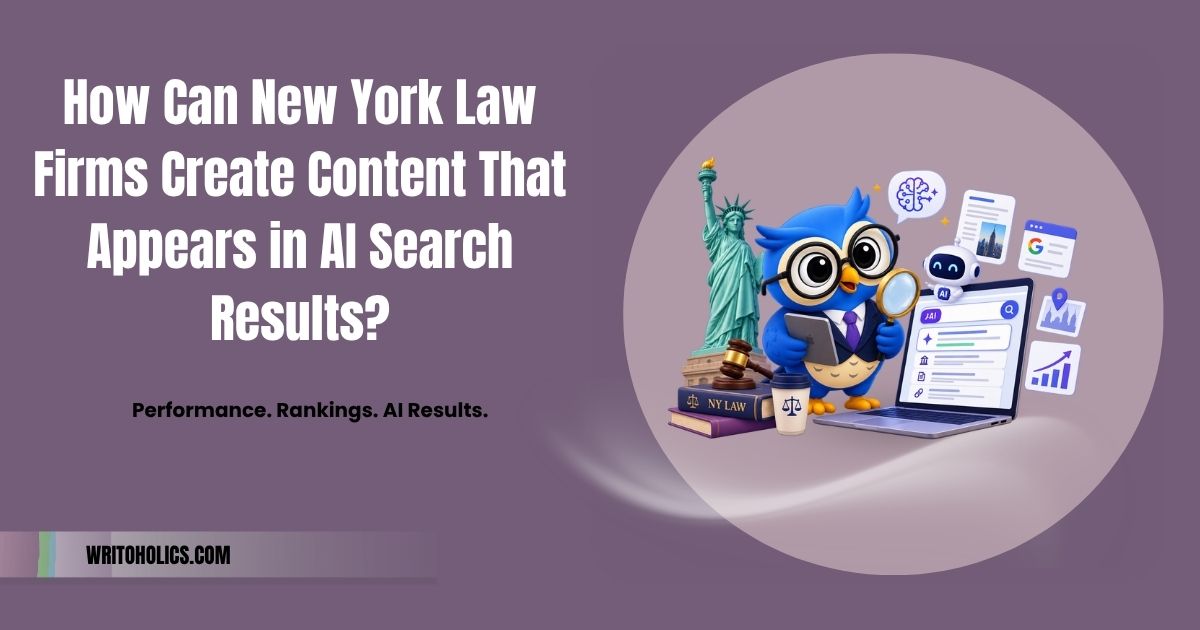
New York law firms get cited in AI answers by publishing pages that answer one client question in the first two sentences, backing that answer with local detail, and keeping their name, address, and phone number identical across the web. AI tools quote content that is clear, sourced, and tied to a real place.
A year ago, no one spoke about AI, but now it’s talk of the town. With the arrival of AI, law firms are focusing less on traditional SEO and more on fancy terms like GEO, which means “Generative Engine Optimization,” not “Global Employment Organization.”
This simply means showing up in AI search results. And it matters now because of the increase in the number of people using large language models, like ChatGPT, Gemini, etc.
The stakes are real. Pew Research Center reported in 2025 that Google users clicked a regular search result in 8% of visits when an AI summary appeared, compared with 15% when it didn't. Learning how to create content that an AI system will quote now matters as much as ranking on page one.
Most firms treat AI search for law firms as a brand-new discipline. It's the old job with less patience for fluff. Here's where to start.
What AI Tools Pull from When Someone Asks for a Lawyer
Say someone in Astoria asks ChatGPT how long a Surrogate's Court case takes. The tool scans for pages that state a clear answer, checks that answer against other sources, and quotes the cleanest version. Whatever shows up in an AI result is a quoted answer, not a ranked list.
AI visibility for law firms is how often, and how accurately, AI tools mention a firm when someone asks a legal question or asks for a lawyer.
Those tools read more than your homepage. Directory listings, review sites, bar association pages, and forum threads all feed the answer. A firm with a sharp website and a neglected The Avvo profile sends mixed signals, and mixed signals get skipped.
How to Create Content an AI Result Can Quote
Here's how to create content that survives the trip from your site into an AI answer:
•Lead with the answer.
•Keep sentences plain.
•Add the local detail only a New York practitioner would know.
Take a landlord-tenant question from the Bronx. A tenant wants to know what to do when the landlord ignores broken heat in January.
A weak page opens with "Landlord-tenant law is complicated." A strong page says the tenant can file an HP action in Bronx Housing Court to force repairs, that a 311 complaint creates a paper trail, and that the court can order the landlord to fix the problem. Then it lists what the tenant should bring: dated photos, copies of texts, and the lease.
That second page is the kind an AI result quotes. It names the court, the process, and the next step. The vague page gives the tool nothing to lift. Legal content writing for AI search works when each answer can stand alone.
Good answer pages follow the same basic structure:
•The question, worded the way a real client would type it, as the heading
• A two-sentence answer directly underneath, with no warm-up
• The New York court or agency involved, named correctly
• A short list of what the reader should gather or do next
•A plain line on when to call a lawyer, with the firm's phone number
Borough by Borough: Why the Same Page Doesn't Work Twice
Location should change what you write, beyond what sits in the footer.
A Queens immigration lawyer serving Jackson Heights and Flushing writes for readers who ask questions in several languages and want to know which office handles what. A Manhattan employment firm writes about the New York City Human Rights Law and the reality of Midtown offices. A Staten Island personal injury practice writes about crashes on the Staten Island Expressway and a courthouse in St. George. Swap the firm name on one page and you've got the same page.
Court names matter. Serious injury cases usually start in the Supreme Court of the State of New York, which surprises people who assume that's the top court. It isn't. The Court of Appeals is.
Probate for a Nassau County estate goes to Surrogate's Court in Mineola, family matters go to Family Court, and rent fights land in Housing Court. Use the right name and, an AI system can match your page to the question.
Picture a Garden City firm writing for an heir whose parent died without a will in Levittown. That page should describe how Nassau's Surrogate's Court handles the case, not paste in a national essay about probate. Families in Westchester deal with White Plains, and families in Suffolk deal with Riverhead.
Legal content for AI search engines rewards this kind of specificity. A New York law firm with offices in two boroughs needs two sets of pages, not one.
Borough pages get abused more than any other tactic. A page that says "We serve Brooklyn" and lists twenty neighborhoods is spam with good manners. A page earns its place by covering something real: the local courthouse, typical timelines, situations common to that area, and the bar association the firm belongs to, whether that's the Brooklyn Bar Association, the Queens County Bar Association, or the Nassau County Bar Association.
The Boring Signals That Decide Who Gets Named
Law firm AI search visibility depends on signals that look dull next to a fresh blog post.
•Your name, address, and phone number written the same way on your site, Google Business Profile, Avvo, Justia, and every bar directory
•A Google Business Profile with correct categories, real hours, and photos of an actual office
•Client reviews that describe the situation in the client's own words, instead of "great lawyer, five stars"
•Borough and neighborhood pages with real substance
•Mentions from local outlets, bar association event pages, and groups like the New York City Bar Association
A firm that moved offices in 2019 and still lists the old suite on three directories is telling the machines two different stories. AI visibility for law firms usually breaks on details like these. Most firms obsess over how to create content and skip the profiles that feed the answer.
Reviews tend to be more useful when they mention the practice area and the place, since "helped me with my Housing Court case in the Bronx" gives an AI tool something to match. "Amazing service" gives it nothing.
What New York's Advertising Rules Mean for Your Website
Rule 7.1 of the New York Rules of Professional Conduct governs attorney advertising, and any New York law firm's website usually falls under it.
The rule expects an "Attorney Advertising" label on the home page, and the exact line "Prior results do not guarantee a similar outcome" alongside result claims or client testimonials. A line like "we will stop your foreclosure" has already drawn a state bar ethics opinion.
Legal content optimization for AI search results doesn't excuse a page from any of this. Keep result claims factual and have your own ethics counsel read the final draft. This is general information, not legal advice, and the rules get revised, so check the current text.
What Wastes Time, and What Most Firms Miss
Time-wasters:
•Thirty near-identical "car accident lawyer in Manhattan” pages
•Prompt tricks passed around on LinkedIn
•Generic law firm AI checklists that stop at " add schema markup"
•Weekly blog posts with nothing New York in them
The misses are quieter. Old posts do damage. New York's Housing Stability and Tenant Protection Act of 2019 changed the rules on rent and evictions, and posts written before it can still describe the old system. An AI tool that sees your page contradict a current source has little reason to quote you. Audit old posts before writing new ones.
Next, ask the tools about your firm. Type "probate lawyer Nassau County" and your own name into ChatGPT, Perplexity, and Google. Sometimes the answer leans on a directory listing with a phone number that hasn't rung since 2011. A third-party page is often feeding the answer, so that's where the fix goes.
Last, put a real attorney's name, bar admission, and years in practice on legal pages. Legal content for AI search carries more trust when someone will stand behind it. Anonymous pages read like nobody will.
Your Front Desk Knows More Than Your Keyword Tool
Ask whoever answers your phones what people say in the first thirty seconds. Those sentences are your headings, word for word. "My landlord won't return my security deposit" beats "tenant rights representation" every time.
AI search for law firms is measurable, so test it monthly. Type ten of those questions into ChatGPT, Gemini, and Perplexity, and record whether your firm appears. Add one line to the intake form: "Did an AI tool mention us?"
Track law firm AI mentions the way you track referrals from a bar association panel. After six months, that tally tells you more than most dashboards, and it shows which practice area deserves the next article.
Knowing how to create content is the smaller half of the work. Knowing what to write about starts at the front desk.
Why New York Law Firms Bring Their Content to Writoholics
Writoholics builds legal content with the local specificity and factual discipline this piece describes, not templated pages with the borough name changed. The team understands the difference between a Bronx Housing Court process and a Nassau County Surrogate's Court filing and writes content firms can defend to their own ethics counsel.
For a New York law firm trying to build durable law firm AI search visibility rather than chase a single algorithm update, that combination of local knowledge and sourcing discipline is the actual differentiator.
Key Takeaways
•Open every page with a direct answer to one specific client question in the first two sentences.
•Name the real New York court, agency, borough, or neighborhood involved, since a generic page with a city name swapped in gives AI tools nothing to quote.
•Keep your name, address, and phone number identical everywhere, and keep your Google Business Profile and reviews current.
•Treat every page as attorney advertising under Rule 7.1, and have ethics counsel review result claims before anything goes live.
•Test your firm monthly by typing your clients' real questions into ChatGPT, Gemini, and Perplexity to see who gets named.
 inquiry@writoholics.com