

 30 Apr 2026
 Get Started Today !
Writoholics focus on content structure that can boost visibility significantly in search engines and generative engines. Place a test order today!
Introduction: What Is AEO in Content Writing?
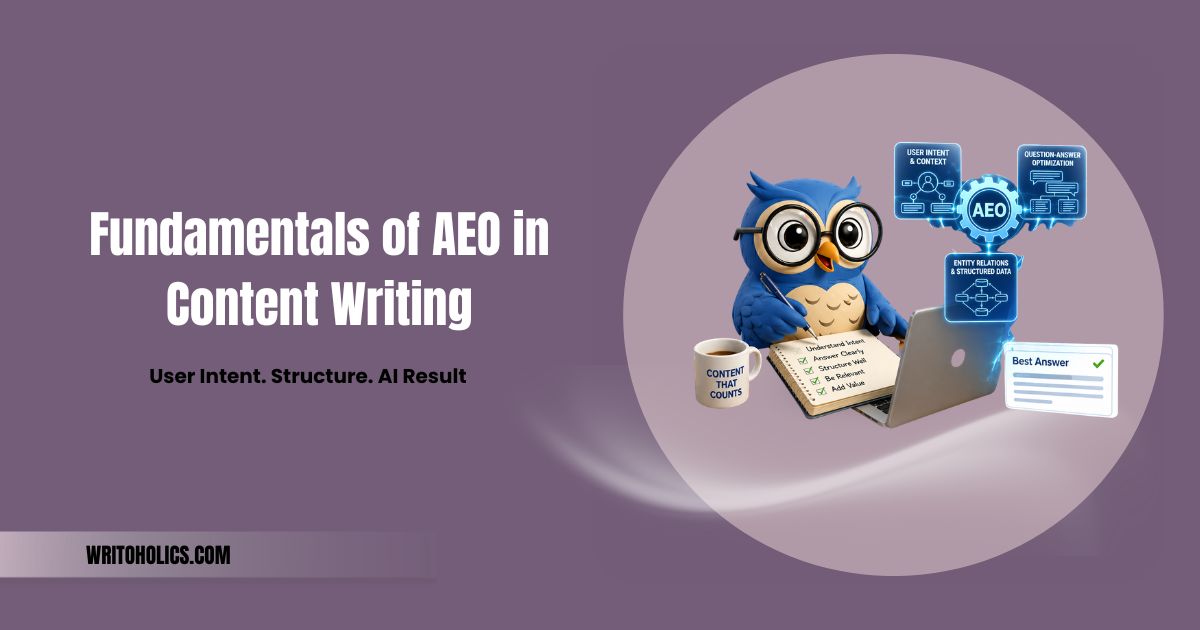
AEO stands for Answer Engine Optimization. AEO in content writing is the process of creating content that directly answers user questions so AI systems, search engines, and voice assistants can instantly deliver your information as the best response.
Today, users no longer search using isolated keywords. Instead of typing “law firms near me,” they ask conversational queries like
- Which law firm delivers real results?
- Why should I choose this service?
- What solution does this law firm give?
Modern AI search systems analyze intent, context, and meaning not just keywords. When AEO-friendly content writing clearly explains concepts and structures information logically, AI platforms extract it for featured snippets, AI summaries, and voice responses.
This evolution explains why AEO's importance for content writing has become one of the most discussed topics in modern digital marketing.
A strong AEO strategy shifts focus from traffic alone toward the following:
- Authority visibility
- AI citation opportunities
- Brand trust signals
- Long-term discoverability
Therefore, the future belongs to content that machines can understand and humans can trust.
The Shift From SEO to AEO
Traditional SEO optimizes content for discovery through keywords, backlinks, and page authority. AEO optimizes content for extraction—so AI systems can pull out precise answers and deliver them instantly.
Search behavior has evolved through three distinct stages:
- Keyword search era: Users typed short phrases; search engines matched exact terms.
- Semantic search era: Algorithms began understanding meaning and intent behind queries.
- Answer engine era: AI systems generate direct answers instead of sending users to multiple pages.
Note:
SEO focuses on visibility.
AEO focuses on extractability.
How Answer Engines Read Your Content
Understanding AEO becomes easier when you know how AI systems process information.
AI systems do not read entire pages the way humans do. When someone searches a question, the process works like this:
- The system identifies the query's intent, not just its keywords.
- It searches indexed, trusted sources for relevant passages.
- It extracts the passage that most directly answers the question.
- It generates a summarized answer, often citing the source.
This means your article must function as a knowledge source, not just a webpage. Every section should be able to independently answer a question.
Key Principle:
Answer first, explain next. If a reader must scroll three paragraphs before finding the answer, an AI system will likely pass over your page entirely.
Modern AI uses several technologies to process content:
- Natural Language Understanding (NLU) — interprets human language, intent, and context rather than matching exact keywords.
- Entity Recognition — identifies key concepts, brands, and topics to understand relationships between ideas.
- Passage Ranking — evaluates specific sections of a page rather than the entire document.
- Retrieval-Augmented Generation (RAG) — combines real web content with AI reasoning to generate accurate, source-backed answers.
Core Principles of AEO in Content Writing
The effectiveness of AEO in content writing depends on a set of foundational principles that align how humans consume information with how AI systems interpret knowledge. These principles go beyond formatting — they shape how content is understood, ranked, and delivered as answers.
A successful AEO strategy ensures every piece of content writing serves two audiences simultaneously:
- Human readers seeking clarity
- AI systems seeking structured answers
Below are the core pillars that define truly AEO-friendly content writing.
1. Answer-First Content Architecture
At the heart of AEO in content writing lies the answer-first model.
Modern answer engines prioritize content that resolves user intent immediately. When AI analyzes a page, it looks for the fastest path to a clear answer. If readers must scroll extensively before finding value, extraction probability drops significantly.
How answer-first writing works:
- Begin sections with a direct explanation
- Define concepts within the first 1–2 sentences
- Avoid long storytelling before answering
- Expand only after clarity is established
Example Structure
- Step 1 — Direct Answer
Provide a concise definition or solution.
- Step 2 — Explanation
Explain how or why it works.
- Step 3 — Context
Add examples, applications, or implications.
- Step 4 — Reinforcement
Summarize key insights naturally.
This layered structure increases snippet eligibility and highlights why AEO is important for content writing today.
2. Intent Mapping and Query Understanding
Traditional optimization focuses on keywords, whereas AEO focuses on intent intelligence.
Every search query contains hidden expectations. Effective AEO-friendly content writing anticipates those expectations before users explicitly ask follow-up questions.
Major Intent Layers
Surface Intent
What the user literally asked.
Informational Intent
What knowledge they actually need.
Contextual Intent
Why they are searching now.
Outcome Intent
What decision or action they want to take.
Strong content writing addresses all four layers within the same article.
For example, someone searching about digital marketing may want the following:
- A definition
- Strategic understanding
- Implementation steps
- Business benefits
Addressing layered intent dramatically improves the benefits of AEO in content writing.
3. Semantic Entity Optimization
AI systems do not think in keywords; they think in entities and relationships.
Entities are identifiable concepts such as:
- Answer engines
- Content writing
- Voice search
- AI snippets
Effective AEO in content writing connects these entities logically throughout the article.
Practical Entity Optimization
Instead of repeating one keyword repeatedly:
- Introduce related concepts naturally
- Explain relationships between ideas
- Reinforce terminology across sections
- Maintain conceptual consistency
This semantic linking helps AI build a knowledge graph around your content, strengthening authority signals and supporting a scalable AEO strategy.
4. Conversational Information Design
One major reason AEO is important for content writing is the rise of conversational search.
Users increasingly interact with AI as if they are speaking to a person. Content must therefore mimic expert conversation rather than academic writing.
Characteristics of conversational AEO writing:
- Clear explanations instead of jargon-heavy sentences
- Natural question-and-answer flow
- Predictive responses to follow-up questions
- Logical progression of ideas
Good AEO-friendly content writing feels like an expert guiding the reader step by step.
AI systems reward content that sounds human while remaining precise.
5. Content Chunking for AI Retrieval
Large blocks of text reduce machine readability.
Modern AEO in content writing divides information into structured knowledge units called content chunks. Each chunk acts as an independent answer candidate.
Effective Chunking Includes
- Short paragraphs (2–4 lines)
- Descriptive subheadings
- Focused topic sections
- Standalone explanations
When properly structured, AI can extract answers without needing full-page interpretation—maximizing the benefits of AEO in content writing.
6. Authority and Expertise Signaling
AEO is fundamentally built on trust.
AI systems evaluate whether content demonstrates real expertise before selecting it as an answer source. This makes authority signals essential in modern content writing.
Strong authority signals include:
- Detailed explanations instead of surface-level tips
- Logical reasoning behind statements
- Updated industry insights
- Conceptual depth rather than promotional tone
A mature AEO strategy positions content as educational rather than purely marketing-focused.
The clearer and more informative the content, the higher its credibility within AI ecosystems.
7. Contextual Reinforcement and Topic Depth
AEO rewards comprehensive understanding.
Rather than discussing topics once, AEO-friendly content writing reinforces key ideas across the article in different contexts.
For example:
- Introduce AEO conceptually
- Explain technically later
- Discuss benefits strategically
- Revisit implications in future trends
This repeated contextual exposure helps AI confirm topical authority.
It also explains why AEO is important for content writing in building long-term visibility rather than short-term rankings.
8. Human Readability + Machine Interpretability Balance
The final principle of AEO in content writing is balance.
Content must achieve two goals simultaneously:
For Humans
- Easy to read
- Informative
- Engaging
For AI Systems
- Structured logically
- Conceptually clear
- Easily extractable
Successful AEO-friendly content writing exists at the intersection of these two requirements.
When executed correctly, the benefits of AEO in content writing extend beyond rankings — content becomes a reliable knowledge asset used repeatedly across AI platforms.
Benefits of AEO in Content Writing
Understanding the benefits of AEO in content writing helps writers adapt to AI-driven discovery platforms.
1. AI Snippet Visibility
Search engines now extract answers directly from webpages. Strong AEO in content writing increases the chance of appearing in AI summaries, featured snippets, and voice search responses.
2. Voice Search Optimization
Smart assistants rely heavily on AEO strategy frameworks. Content written with conversational clarity performs better in spoken queries.
3. Zero-Click Searches
Users often receive answers without visiting websites. Only AEO-friendly content writing ensures your brand becomes the cited source.
4. Higher Authority Signals
Structured answers signal expertise, improving trustworthiness and domain authority.
5. Future-Proof Content Marketing
The benefits of AEO in content writing include longevity, since AI systems increasingly dominate information delivery.
AEO vs SEO: Key Differences
| Feature | SEO | AEO |
| Goal | Rankings on result page | Being the cited answer |
| Focus | keywords and backlinks | User intent and context |
| Format | Long form pages | Structured,extractable chunks |
| Traffic Model | Click based visits | Zero click visibility |
| optimized for | Crawlers and Algorithms | AI retrieval systems |
| Succes Metric | Page rank position | Snippet and citation rate |
Modern AEO in content writing complements SEO rather than replacing it.
Common Mistakes to Avoid in AEO
Even well-written content can fail in answer engines when small structural issues reduce extractability.
1. Treating AEO as Keyword Optimization
AEO is not advanced SEO keyword stuffing. Content must answer real questions clearly rather than repeat phrases.
2. Burying the Answer
If the main insight appears too late, AI systems may skip the page entirely. Deliver the solution early.
3. Overwriting Instead of Clarifying
Length does not equal authority. Concise explanations outperform long descriptive sections.
4. Writing One-Dimensional Content
Content that only defines a topic — without explaining use, impact, or outcomes — rarely becomes an AI citation source.
5. Ignoring Structure
Poor headings, long paragraphs, and unclear sections make extraction difficult even if the information is valuable.
Key Insight:
AEO success depends less on how much you write and more on how clearly knowledge is organized.
Ready to Implement AEO? Work With Writoholics
If you want content that ranks in AI snippets, voice search, and future AI search platforms, professional expertise makes the difference.
At Writoholics, we specialize in advanced AEO in content writing, strategic content writing, and scalable AI-optimized publishing systems designed for measurable growth.
We offer flexible packages:
⦁ Bronze
⦁ Silver
⦁ Gold
⦁ Platinum
⦁ Diamond
Not sure which suits your business? Our team will analyze your goals and recommend the ideal strategy.
Visit writoholics.com today and transform your content into AI-ready authority assets.
Start ranking answers not just webpages.
Key Takeaways
⦁AEO (Answer Engine Optimization) is the practice of structuring content so AI systems can easily identify, extract, and present answers to user questions.
⦁Modern search engines prioritize content that explains topics clearly, matches user intent, and delivers information without unnecessary complexity.
⦁Answer-first writing, logical organization, and conversational clarity help content become eligible for AI summaries, featured snippets, and voice search responses.
⦁AI platforms evaluate content using meaning, context, and entity relationships rather than keyword repetition alone.
⦁Well-structured content divided into clear sections improves readability for users while increasing extractability for answer engines.
⦁Demonstrating expertise, contextual depth, and consistent topic reinforcement strengthens authority signals recognized by AI systems.
⦁AEO complements traditional SEO by transforming articles into reliable knowledge sources designed for long-term visibility across AI-driven search experiences.

.jpg)