

 07 Aug 2026
 Get Started Today !
Writoholics focus on content structure that can boost visibility significantly in search engines and generative engines. Place a test order today!
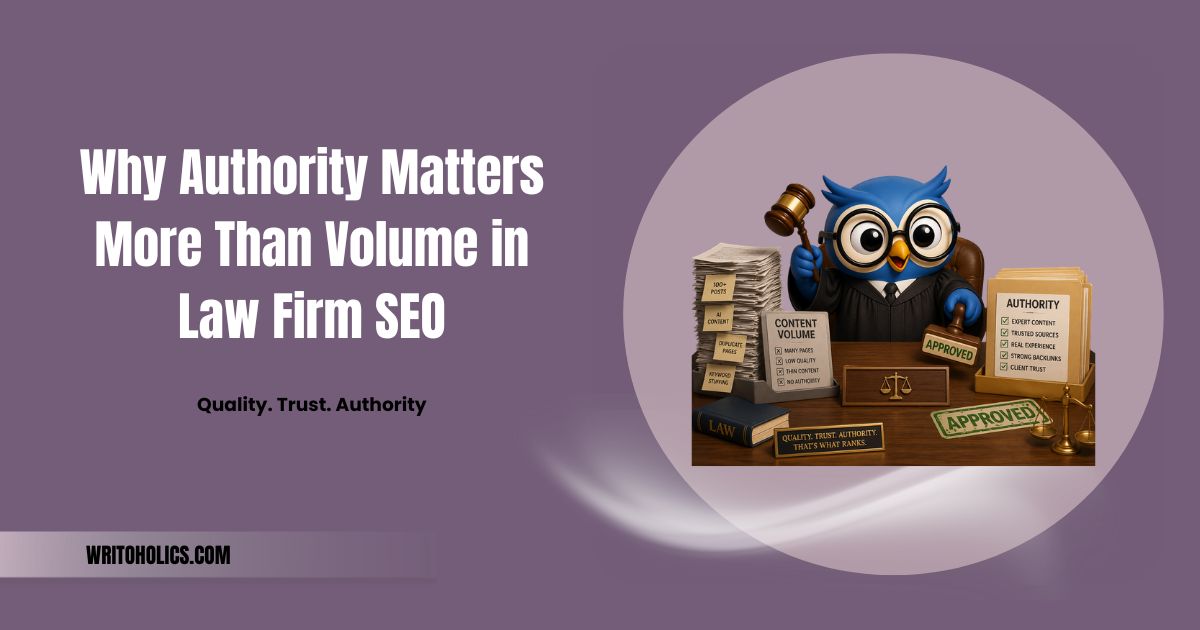
Authority beats volume in law firm SEO because Google treats legal content as high-stakes information, the kind that can affect someone's freedom, finances, or family. A firm with twenty pages written and reviewed by real attorneys will consistently outrank a firm publishing two hundred generic blog posts a year.
Google's Search Quality Rater Guidelines classify legal topics under "Your Money or Your Life" content, meaning the algorithm actively rewards demonstrated expertise and penalizes thin, unverified pages, no matter how many of them you publish.
Here's a stat that should reframe how most firms think about content.
Clio's research found that 77% of consumers want to know a lawyer's experience and credentials before they'll reach out. Not pricing. Not flashy design.
People searching for a lawyer are scared, confused, or in some kind of legal trouble, and they're scanning for proof that the person on the other side of the screen actually knows what they're doing. Volume can't fake that. A hundred keyword-stuffed articles won't convince anyone you've won a case like theirs.
This is where the phrase "law firm SEO" gets misunderstood. Most agencies sell it like generic content writing services: pump out pages targeting every long-tail keyword variation you can think of, and rankings will follow.
That approach worked around 2015. It doesn't work now, because Google's ranking systems got much better at telling the difference between a page written by someone who's actually practiced family law for fifteen years and a page written to hit a word count.
Authority building isn't a bonus feature of legal SEO. It's the foundation the entire ranking system sits on, especially for practice areas where a wrong answer has real consequences.
What "Authority" Actually Means in Legal SEO
Authority, in the SEO sense, is a mix of signals that tell Google and AI answer engines that this source is credible enough to trust for a legal question. It includes author credentials, citations from courts or bar associations, consistent topical depth, and a track record of accurate information.
Volume, on the other hand, is just page count. You can have a lot of one without much of the other.
A quick way to picture the difference. Imagine two personal injury firms in the same city. Firm A publishes four articles a month, each written by a paralegal skimming competitor content.
Firm B publishes one article a month, drafted with a legal content writer working directly from the trial attorney's notes, citing the specific state statute, referencing a real settlement range, and answering the exact question a client typed into Google at 11 P.M. after an accident.
Firm B wins. Not eventually. Within a few months of consistent publishing, because Google's E-E-A-T (Experience, Expertise, Authoritativeness, Trustworthiness) framework is built to reward exactly this pattern.
Here's a more neat definition.
Content authority in legal SEO is the measurable trust a search engine assigns to a page based on who wrote it, how accurate it is, and how well it's supported by credible external signals like citations, reviews, and backlinks from legitimate legal sources.
Why Volume-First Strategies Keep Failing Law Firms
There are firms that burn six-figure marketing budgets chasing publishing quotas. The pattern is always the same:
- An agency promises "50 blog posts a month" for rapid ranking growth.
- The content gets outsourced to generalist writers with zero legal background.
- Pages start ranking briefly, then drop after a core update because Google recalculates trust signals
Google's core updates over the last several years have specifically targeted this exact playbook. Sites stuffed with generic, unauthored, or AI-generated legal content without any real expert oversight took the biggest hits. Meanwhile, smaller firms with tighter, attorney-reviewed content libraries often performed better.
There's a nuance most SEO guides skip. It's not that AI-assisted content is banned or penalized outright. Google has said repeatedly that quality matters more than how content was produced.
The issue is that most volume-driven content, AI-written or not, skips the verification step. Nobody with a law degree checked whether the statute cited is still current, whether the case law reference is accurate, or whether the advice matches the actual jurisdiction being targeted.
How to Build Authority for Law Firm SEO (The Practical Version)
Building real authority takes longer than mass production, but the payoff compounds instead of decaying. A few things actually make a difference:
Attorney bylines with real bios. Every substantive page should list which attorney wrote or reviewed it, along with their bar number, years practicing, and relevant case history. This single change often does more for rankings than ten new blog posts.
Original case data instead of recycled statistics. If a firm has handled two hundred DUI cases in a county, publishing anonymized outcome data (average reduction in charges, typical timelines) creates content nobody else can copy. That's a real authority signal, and it happens to make genuinely useful content for readers too.
Citations from courts, statutes, and bar associations. Linking to the actual state code section, a specific court ruling, or a bar association resource tells both readers and search engines the content is grounded in something verifiable, not just paraphrased from a competitor's page.
Topical authorityover topical breadth. A firm practicing exclusively immigration law that builds out deep, interconnected content around every visa category, appeals process, and USCIS timeline will beat a general practice firm that touches immigration alongside eight other practice areas. Depth in one area reads as expertise. Spreading thin across everything reads as generic.
This is the difference between SEO authority and just having a website that exists. One tells search engines, "Trust this"; the other just occupies space.
AEO Changes the Math Even More
Answer engines like ChatGPT, Perplexity, and Google's AI Overviews pull information to answer questions directly, often skipping the click to a website entirely. That shift raises the stakes on authority even further, because these systems are even more conservative about which sources they'll quote for legal topics.
An AI answer engine citing a law firm's page as a source for "what happens if I get arrested for a first DUI in Boston" is effectively vouching for that firm's credibility to a user who never even visits the site.
Getting cited requires the same ingredients as ranking well in traditional search: clear, accurate, well-attributed content that answers the exact question being asked, without unnecessary information.
A legal SEO content strategy built for AEO looks less like a keyword list and more like a set of precise, self-contained answers. Each page should be able to stand alone as a direct response to one specific legal question, written the way an attorney would actually explain it to a client sitting across the desk, statute references and all.
Why Authority Matters in Law Firm SEO
Rankings built on volume are fragile. A single core update can wipe out a year of publishing effort overnight, because the underlying content never had real trust signals holding it up.
Rankings built on authority tend to survive updates, because the signals Google checks (expert authorship, citations, consistent accuracy, real user trust through reviews) don't disappear just because an algorithm shifted.
There's also a compounding effect that most firms underestimate. Once a firm establishes topical authority in a practice area, new content in that same area ranks faster. Google already trusts the domain for this subject matter, so a new page about, say, wrongful termination claims benefits from every previous employment law page the firm has published.
Volume-first sites don't get this benefit because their content is scattered across too many unrelated topics to build a coherent trust profile in any one of them.
SEO legal marketing that prioritizes authority also tends to convert better, independent of rankings. A visitor who lands on a page written by a named attorney, backed by real case outcomes and accurate statute citations, is far more likely to pick up the phone than someone who lands on a generic, unattributed article that could belong to any firm in any state.
A Quick Check for Firms Auditing Their Own Content
Before investing more budget into either direction, it's worth asking a few blunt questions about existing content:
- Does every practice area page name the specific attorney behind it, with real credentials?
- Are statute and case law references current and jurisdiction-specific, not generic?
- Would this page answer a real client's question better than a competitor's, or does it just exist to target a keyword?
If most answers land on the wrong side, more volume will only scale the problem. Fixing the existing pages first, adding attorney oversight, real citations, and original insight, usually produces faster ranking movement than doubling publishing output ever will.
Law firm marketing built on authority isn't the flashier pitch. It's harder to sell as a monthly retainer because it doesn't produce a big content calendar to point to.
What it does produce is a website Google and AI systems are willing to trust with questions that genuinely matter to the person asking them, which is the entire point of showing up in search results for a law firm in the first place.
Bringing In Writoholics for the Content Gap
This is the real bottleneck for most firms. Legal writing content that holds up takes someone who can read a jurisdiction's statutes, translate an attorney's actual expertise into plain English, and structure the page so it works for search and for AI answer engines too.
Most in-house teams don't have anyone who does all three. Asking an attorney to review thirty pages a month on top of billable work isn't realistic either.
Writoholics builds content industry by industry instead of running everything through one template. For a firm that wants its content handled without pulling attorney time away from casework, that's the kind of setup worth having.
Key Takeaways
- Legal content gets extra scrutiny from Google because bad advice can cost someone money or their freedom.
- Most people check a lawyer's credentials before calling, so a named attorney beats a generic page every time.
- Pages written and reviewed by an actual attorney tend to beat a pile of unattributed ones.
- Thin content gets hit hardest in Google updates; attorney-reviewed pages hold up better.
- AI tools like ChatGPT only cite sources they trust, so the bar for accuracy just got higher.
- If attorneys don't have time to write and check content, that's the real gap firms need to fill.


 inquiry@writoholics.com